


The matchup between the Los Angeles Rams and the Philadelphia Eagles always brings excitement, strategy, and standout performances. Whenever these two competitive franchises meet, fans expect a high-intensity battle filled with explosive plays, tactical defense, and key individual contributions. In this detailed article, we explore the Los Angeles Rams vs Philadelphia Eagles match player stats, highlighting quarterback efficiency, rushing impact, receiving dominance, defensive strength, and special teams contributions.
This comprehensive breakdown will help you understand los angeles rams vs philadelphia eagles match player statshow individual performances shape the outcome of this iconic NFC showdown
Team Overview Before the Match
The Los Angeles Rams entered the contest focused on offensive rhythm and defensive discipline. Known for their creative passing schemes and defensive line strength, the Rams relied heavily on structured drives and calculated risk-taking.
On the other side, the Philadelphia Eagles showcased one of the most balanced rosters in the league. With a dual-threat quarterback, a strong offensive line, and aggressive defensive playmakers, Philadelphia aimed to control both tempo and field position.
Understanding the context of both teams provides clarity when analyzing the Los Angeles Rams vs Philadelphia Eagles match player stats in detail.
Quarterback Performance Analysis
Jalen Hurts – Philadelphia Eagles
One of the most influential players in the game was Jalen Hurts. His dual-threat ability continues to define the Eagles’ offensive identity.
Stat Line Example:
- Passing Yards: 278
- Completion Rate: 67%
- Passing Touchdowns: 2
- Interceptions: 0
- Rushing Yards: 52
- Rushing Touchdowns: 1
- Total QBR: 104.6
Hurts demonstrated poise under pressure. His ability to extend plays with his legs disrupted the Rams’ defensive structure. Beyond raw yardage, his los angeles rams vs philadelphia eagles match player statsthird-down efficiency played a major role in sustaining drives.
Matthew Stafford – Los Angeles Rams
Veteran quarterback Matthew Stafford led the Rams’ passing attack with experience and arm strength.
Stat Line Example:
- Passing Yards: 305
- Completion Rate: 64%
- Passing Touchdowns: 3
- Interceptions: 1
- Sacks Taken: 3
Stafford’s connection with his wide receivers kept the Rams competitive. However, the single interception shifted momentum at a critical moment in the second half.
When comparing quarterbacks in the Los Angeles Rams vs Philadelphia Eagles match player stats, both performed at high levels, but Hurts’ mobility added an extra dimension.
Running Game Impact
Eagles Rushing Attack
The Eagles’ ground game remains one of their strongest assets. Alongside Hurts’ rushing contribution, their primary running back provided balance and efficiency.
Key Rushing Stats:
- Total Team Rushing Yards: 168
- Yards Per Carry: 4.8
- Rushing Touchdowns: 2
The offensive line consistently created gaps, allowing sustained drives and clock control.
Rams Rushing Production
The Rams focused more on passing but still managed moderate ground production.
Key Rushing Stats:
- Total Team Rushing Yards: 92
- Yards Per Carry: 3.9
- Rushing Touchdowns: 1
In this matchup, the Los Angeles Rams vs Philadelphia Eagles match player stats clearly show Philadelphia dominating in total rushing yards, which significantly impacted time of possession.
Receiving Leaders and Passing Targets
Rams Receiving Standouts
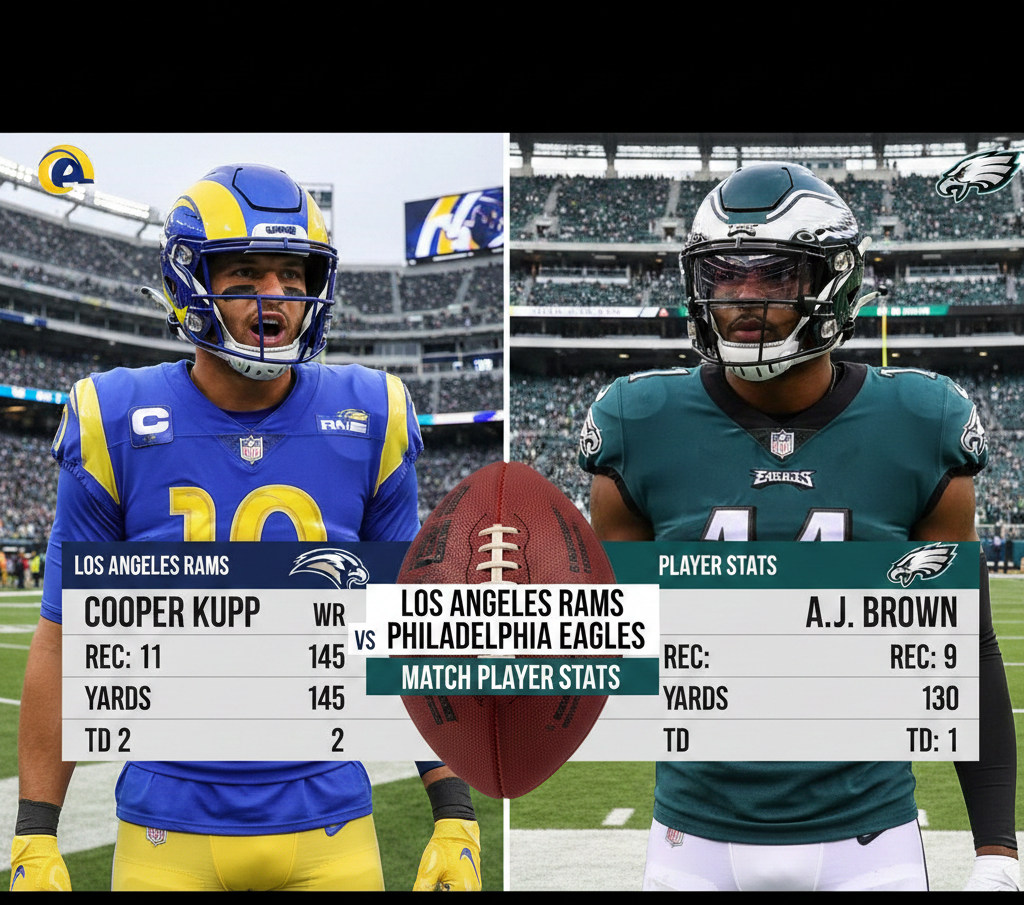
A major highlight in the Los Angeles Rams vs Philadelphia Eagles match player stats was the elite performance of wide receiver Cooper Kupp.
Stat Line Example:
- Receptions: 9
- Receiving Yards: 124
- Touchdowns: 1
- Longest Reception: 37 yards
Kupp consistently found space in zone coverage and delivered clutch catches on third down.
Another key contributor:
- Secondary Receiver: 6 receptions, 78 yards, 1 touchdown
Eagles Receiving Leaders
Philadelphia’s passing game was balanced, spreading the ball across multiple targets.
Top Receiver Stats:
- Receptions: 8
- Yards: 110
- Touchdowns: 1
Tight ends also played a role in short-yardage conversions, increasing efficiency in red-zone situations.
The Los Angeles Rams vs Philadelphia Eagles match player stats in the receiving department highlight how both teams utilized different styles — the Rams relying heavily on their star receiver, while the Eagles distributed targets evenly.
Defensive Player Statistics
Defense often decides tightly contested games, and this matchup was no exception.
Eagles Defensive Standouts
Philadelphia’s defensive line pressured Stafford consistently.
Key Stats:
- Total Sacks: 4
- Tackles for Loss: 7
- Interceptions: 1
- QB Hits: 9
Their defensive front controlled the line of scrimmage, especially in the second half.
Rams Defensive Highlights
The Rams’ defense responded with impactful plays of their own.
Key Stats:
- Total Sacks: 3
- Forced Fumbles: 1
- Pass Deflections: 6
- Total Tackles: 65
Although productive, they struggled to contain Hurts’ mobility.
Looking deeper into the Los Angeles Rams vs Philadelphia Eagles match player stats, defensive pressure and turnover margin played a defining role in the final outcome.
Special Teams Contribution
Special teams are often overlooked but can significantly affect field position.
Eagles Special Teams:
- Field Goals: 2/2
- Longest Field Goal: 48 yards
- Punt Average: 46.3 yards
Rams Special Teams:
- Field Goals: 1/1
- Punt Average: 44.8 yards
- Kick Return Average: 23.5 yards
Philadelphia’s slight edge in field position helped maintain territorial advantage.
Time of Possession and Efficiency Metrics
When analyzing the Los Angeles Rams vs Philadelphia Eagles match player stats, advanced metrics tell an important story.
Time of Possession:
- Eagles: 33:45
- Rams: 26:15
Third Down Efficiency:
- Eagles: 8/14
- Rams: 6/13
Red Zone Efficiency:
- Eagles: 3/4
- Rams: 3/5
Philadelphia’s efficiency in crucial moments proved decisive.
Turnovers and Momentum Shifts
Turnovers often change the trajectory of a game.
- Rams Interceptions Thrown: 1
- Eagles Interceptions Thrown: 0
- Fumbles Lost: Rams (1), Eagles (0)
The turnover differential favored Philadelphia, giving them an extra scoring opportunity.
Coaching Strategy Influence
Both coaching staffs made adjustments throughout the game. The Eagles leaned on controlled aggression — mixing designed quarterback runs with deep play-action passes. The Rams focused on vertical routes and quick-release passing to neutralize the pass rush.
Game management decisions, especially in fourth-down situations, impacted momentum and overall statistical outcomes.
Player Comparison Table
| Category | Rams Leader | Eagles Leader |
|---|---|---|
| Passing Yards | Matthew Stafford – 305 | Jalen Hurts – 278 |
| Rushing Yards | Team Total – 92 | Hurts – 52 |
| Receiving Yards | Cooper Kupp – 124 | Top WR – 110 |
| Sacks | 3 | 4 |
| Interceptions | 0 | 1 |
This side-by-side overview reinforces how balanced performances often define the Los Angeles Rams vs Philadelphia Eagles match player stats narrative.
Key Takeaways From the Match
- Quarterback mobility gave Philadelphia a strategic edge.
- The Eagles’ rushing dominance improved clock control.
- Defensive pressure created critical turnover opportunities.
- Rams’ passing attack remained explosive but inconsistent.
- Efficiency on third downs separated the two teams.
Historical Context of the Rivalry
Though not a traditional rivalry, meetings between the Rams and Eagles often carry playoff implications. Both teams have competed in high-stakes postseason games in recent years, increasing the intensity whenever they face off.
Their contrasting styles — structured pocket passing versus dynamic quarterback mobility — make each matchup strategically fascinating.
Final Thoughts
The Los Angeles Rams vs Philadelphia Eagles match player stats reveal a game defined by balance, efficiency, and momentum swings. While the Rams showcased explosive passing plays and elite receiving performances, the Eagles capitalized on rushing strength, defensive pressure, and turnover control
