


The matchup between the Indiana Fever and the Chicago Sky has quickly become one of the most talked-about rivalries in the WNBA. With rising stars, elite veterans, and intense fourth-quarter battles, every meeting between these two franchises offers compelling storylines and impressive individual performances.
In this in-depth article, we’ll analyze player statistics, team comparisons, scoring distribution, rebounding impact, defensive metrics, bench production, and key tactical factors that shape the outcome of an Indiana Fever vs Chicago Sky matchup.
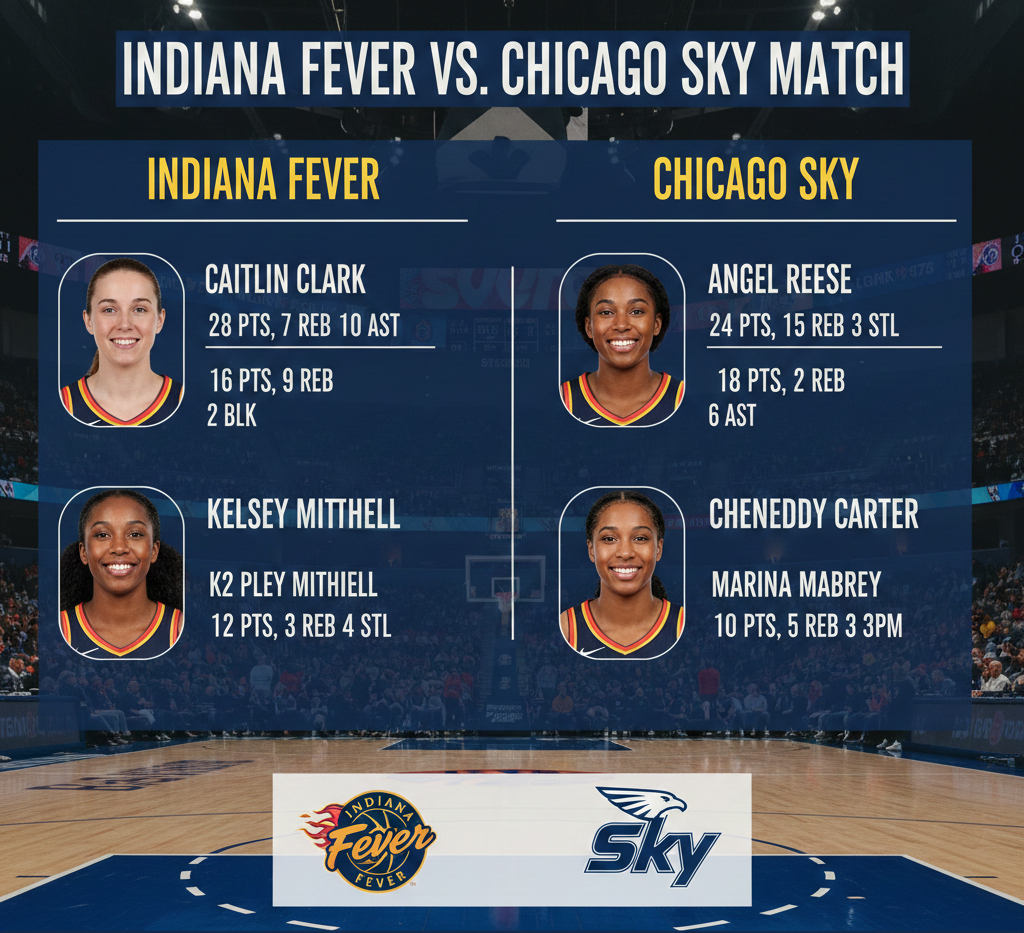
indiana fever vs chicago sky match player stats
Whenever these teams meet, the game typically showcases:
- Fast-paced offensive sequences
- Strong rebounding contests
- Physical paint battles
- High guard production
- Intense fourth-quarter execution
Both rosters are built differently. Indiana leans heavily on young talent and perimeter creativity, while Chicago combines frontcourt strength with balanced offensive contributions.
Team Performance Snapshot
Indiana Fever – Team Statistics Overview
Typical key statistical categories in this matchup include:
- Points scored: 78–90 range
- Field goal percentage: 42–47%
- Three-point percentage: 33–40%
- Total rebounds: 34–42
- Assists: 18–24
- Turnovers: 12–17
Indiana’s strength lies in transition offense and guard play. When they move the ball effectively and limit turnovers, their offensive rhythm becomes difficult to stop.
Chicago Sky – Team Statistics Overview
Chicago often counters with:
- Points scored: 75–88 range
- Field goal percentage: 43–48%
- Three-point percentage: 30–37%
- Total rebounds: 36–45
- Assists: 16–22
- Turnovers: 13–18
The Sky typically focus on paint indiana fever vs chicago sky match player stats scoring and second-chance opportunities. Their rebounding often keeps them competitive even when outside shooting struggles.
Key Player Statistical Breakdown
Indiana Fever Player Stats
Caitlin Clark – Guard Performance Analysis
Caitlin Clark plays a central role in this matchup.
Typical stat line vs Chicago:
- Points: 20–30
- Assists: 6–10
- Rebounds: 4–7
- Three-pointers made: 3–6
- Turnovers: 3–6
Clark’s deep shooting range stretches Chicago’s defense. When she hits early threes, defensive adjustments open driving lanes for teammates.
Her assist numbers often increase against Chicago due to defensive traps that force her to pass out of pressure.
Aliyah Boston – Frontcourt Impact
Aliyah Boston provides interior stability.
Average impact metrics:
- Points: 14–20
- Rebounds: 8–12
- Blocks: 1–3
- Field goal percentage: 50%+
Boston’s efficiency in the paint helps Indiana counter Chicago’s physical frontcourt. Her rebounding battles often determine indiana fever vs chicago sky match player stats second-chance points.
Kelsey Mitchell – Scoring Suppor
Kelsey Mitchell contributes perimeter scoring and mid-range efficiency.
Typical contributions:
- Points: 15–22
- Assists: 2–4
- Three-point percentage: 35–45%
Mitchell’s off-ball movement forces Chicago defenders to stay attached, creating spacing advantages.
Chicago Sky Player Stats
Angel Reese – Rebounding Machine
Angel Reese is often the rebounding leader in this matchup.
Typical stat line:
- Points: 14–22
- Rebounds: 10–16
- Offensive rebounds: 3–6
- Double-doubles: Frequent
Reese’s ability to secure second-chance opportunities often shifts momentum. Against Indiana, her rebounding numbers are indiana fever vs chicago sky match player stats particularly impactful.
Marina Mabrey – Backcourt Production
Marina Mabrey provides perimeter scoring and veteran leadership.
Common performance stats:
- Points: 13–20
- Assists: 3–6
- Three-pointers made: 2–4
Mabrey’s ability to respond to scoring runs makes her a stabilizing force.
Kamilla Cardoso – Interior Defense
Kamilla Cardoso anchors Chicago’s paint defense.
Defensive contributions:
- Blocks: 1–4
- Rebounds: 7–11
- Points: 8–14
Cardoso’s rim indiana fever vs chicago sky match player stats protection can disrupt Indiana’s drive-and-kick offense.
Quarter-by-Quarter Statistical Trends
First Quarter
Indiana often starts aggressively from the perimeter. If Clark connects early from deep, the Fever usually gain a 5–8 point advantage.
Chicago, however, relies on early offensive rebounds to stay clos
Second Quarter
Bench production becomes critical:
- Indiana bench scoring: 12–18 points
- Chicago bench scoring: 10–16 points
Turnovers often increase during this stretch due to defensive substitutions.
Third Quarter
This quarter often determines control:
- Fast-break points
- Defensive adjustments
- Foul trouble impact
Reese and Boston typically battle indiana fever vs chicago sky match player stats heavily in this period for rebounding dominance.
Fourth Quarter
Clutch metrics matter:
- Free throw percentage
- Assist-to-turnover ratio
- Defensive stops
- Shot selection
Games between these teams are often decided by fewer than 8 points.
Advanced Statistical Metrics
Offensive Rating Comparison
- Indiana Offensive Rating: Mid-to-high tier when shooting above 35% from three
- Chicago Offensive Rating: Stronger when paint points exceed 40
Defensive Rating Comparison
- Indiana improves defensively when limiting offensive rebounds
- Chicago improves when forcing 15+ turnovers
Rebounding Battle Analysis
Rebounding is arguably the indiana fever vs chicago sky match player stats most decisive category in this matchup.
Key Numbers:
- Total rebounds difference often within 5
- Offensive rebound margin frequently determines outcome
Angel Reese vs Aliyah Boston matchups heavily influence this category.
Assist Distribution and Ball Movement
Indiana thrives on ball movement.
When Clark records 8+ assists:
- Indiana win probability increases significantly
Chicago focuses more on individual shot creation, but when Mabrey distributes effectively, scoring becomes balanced.
Three-Point Shooting Comparison
Indiana typically attempts indiana fever vs chicago sky match player stats more three-pointers.
- Fever attempts: 22–30 per game
- Sky attempts: 15–22 per game
If Indiana shoots above 38% from three, Chicago struggles to recover.
Turnover Impact
Turnovers often decide close contests.
- Indiana losses often occur when turnovers exceed 16
- Chicago struggles when forced into rushed perimeter shots
Defensive pressure from both teams increases in late-game situations.
Bench Contributions
Indiana Bench
- Energy players
- Defensive specialists
- Transition scorers
Bench points can swing momentum, especially in back-to-back games.
Chicago Bench
- Interior depth
- Physical defense
- Rebounding reinforcement
When Chicago’s bench wins the rebounding indiana fever vs chicago sky match player stats margin, the Sky usually control pace.
Head-to-Head Statistical Themes
Across recent meetings, common patterns include:
- Double-digit performances from both star guards
- At least one player recording a double-double
- Rebounding difference under 6
- Fourth-quarter scoring surges
Tactical Matchup Analysis
Indiana’s Strategy
- Space the floor
- Increase tempo
- Maximize pick-and-roll efficiency
- Create mismatches for Clark
Chicago’s Strategy
- Dominate the paint
- Slow pace
- Crash offensive boards
- Force contested perimeter shots
Defensive Matchups
Key defensive pairings often include:
- Clark vs Mabrey perimeter battles
- Boston vs Reese interior duels
- Cardoso protecting the rim against Indiana drives
Switching defenses can alter assist distribution patterns significantly.
Clutch Player Statistics
In games decided indiana fever vs chicago sky match player stats by 5 points or fewer:
- Clark often attempts final possessions
- Mabrey frequently handles closing shots
- Free throw accuracy above 85% becomes critical
Statistical Keys to Victory
For Indiana Fever
- 35%+ three-point shooting
- Under 14 turnovers
- Rebounding deficit under 3
- 20+ assists
For Chicago Sky
- 12+ offensive rebounds
- 45%+ field goal percentage
- 40+ paint points
- Double-digit fast-break defense stops
Historical Context of the Rivalry
The Fever and Sky have met in multiple competitive seasons, with both franchises rebuilding around young cores.
This emerging rivalry has gained national attention due to:
- Rookie star performances
- Physical post play
- Intense fan engagement
- Close finishes
Statistical Leaders in Recent Matchups
Common indiana fever vs chicago sky match player stats leaders in points:
- Clark
- Mitchell
- Mabrey
Rebounding leaders:
- Reese
- Boston
- Cardoso
Assist leaders:
- Clark
- Mabrey
Impact of Foul Trouble
Foul trouble often shifts the game dramatically.
- If Boston accumulates early fouls, Indiana’s interior defense weakens
- If Reese is limited, Chicago loses rebounding edge
Free throws become a major factor when games tighten late.
Pace of Play Comparison
indiana fever vs chicago sky match player stats prefers:
- Faster possessions
- Quick transition scoring
- Early shot clock attempts
Chicago prefers:
- Half-court sets
- Post entries
- Controlled offensive execution
The team that dictates tempo usually gains statistical advantage.
Player Efficiency Insights
Efficiency indiana fever vs chicago sky match player stats rating increases when:
- Shot selection improves
- Turnovers decrease
- Defensive rebounds convert into transition
Clark’s efficiency spikes when assist-to-turnover ratio exceeds 2:1.
Reese’s efficiency rises with double-digit rebounds and limited fouls.
Psychological Edge and Momentum Swings
Momentum in this matchup often shifts after:
- Consecutive three-pointers
- Offensive rebound put-backs
- Defensive blocks
- Fast-break layups
Crowd energy can significantly influence late-game runs.
Future Outlook for Both Teams
With young cores developing rapidly, future Indiana Fever vs Chicago Sky matchups promise:
- Higher scoring outputs
- Improved defensive schemes
- Elevated player efficiency
- Increased national spotlight
Both franchises are building around cornerstone players, making statistical improvements each season.
Final Thoughts
The Indiana Fever vs Chicago Sky match player stats reveal more than just numbers. They highlight contrasting styles, rising talent, and evolving team identities.
Key takeaways:
- Rebounding often determines winner
- Perimeter shooting can shift momentum instantly
- Star players consistently deliver high-impact performances
- Turnovers remain decisive in close games
As these teams continue to develop, their statistical battles will only grow more compelling. Each game adds new data points, deeper rivalries, and unforgettable performances
